Responsible Gambling at Pub Casino
At Pub Casino, we take safer gambling seriously. Our platform exists to inform, guide, and support players across the United Kingdom — and that responsibility extends far beyond publishing reviews and bonus guides. We believe that access to reliable, honest information about gambling risks is just as important as any casino recommendation we make.
Gambling, when approached with care and clear boundaries, can be an enjoyable leisure activity. However, we recognise that for some people it can develop into something harmful — affecting finances, relationships, mental health, and daily functioning. This page brings together practical guidance, honest advice, and trusted UK resources to help you stay in control, identify warning signs early, and find the right support if things have become difficult.
Whether you are a regular gambler looking to reassess your habits, someone concerned about a loved one, or a person actively seeking help, this page is designed for you. Please read through the sections below, follow the links to specialist support services, and do not hesitate to reach out to us if you have any questions about the content we provide.
Understanding the Risks Behind the Reels
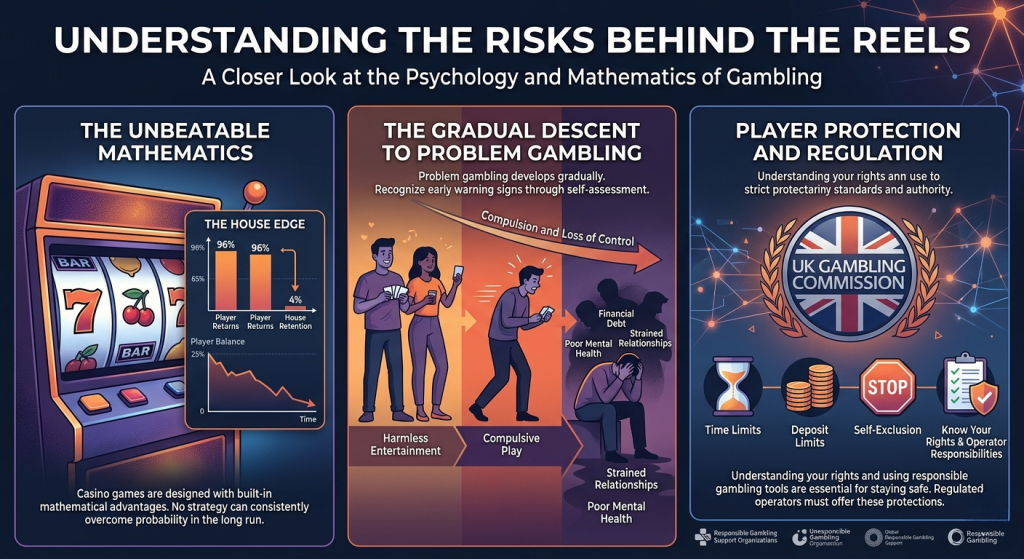
Every casino game — whether it is a slot machine, a live roulette wheel, or a sports bet — is built on probability that favours the house. This is not a secret; it is a mathematical certainty called the house edge. Over time, no strategy, system, or lucky streak can consistently overcome it. Understanding this fundamental reality is the first step towards gambling responsibly.
Problem gambling does not typically appear overnight. It usually develops gradually, often beginning as harmless entertainment before slowly becoming something more compulsive. Many people do not recognise the shift until significant damage has already been done. Financial debt, strained relationships, and deteriorating mental health are common consequences — all of which are preventable with early awareness and honest self-assessment.
The UK Gambling Commission regulates all licensed gambling operators in Great Britain, setting strict standards around player protection. Understanding your rights as a consumer, and knowing what responsible operators are required to offer you, is an important part of staying safe.
Is Your Gambling Still in Your Control?
One of the most important questions any gambler can ask themselves is whether they are still fully in control of their gambling behaviour. This does not mean asking whether you win or lose — it means honestly examining your habits, emotional state, and motivations. The following warning signs are worth reflecting on carefully.
Behavioural warning signs to watch out for:
- Spending more money or time gambling than you originally intended
- Feeling restless, irritable, or anxious when trying to cut down or stop
- Returning to gambling to win back money you have already lost (chasing losses)
- Hiding your gambling habits from family members, friends, or partners
- Using gambling as a way to escape stress, anxiety, depression, or boredom
- Borrowing money or selling possessions to fund gambling activity
- Neglecting work, study, or family responsibilities because of gambling
- Feeling guilt or shame after gambling sessions yet continuing regardless
- Telling yourself you will stop after the next win — and not stopping
Identifying yourself in even two or three of these points does not mean you have a serious addiction, but it does suggest that your gambling behaviour deserves closer attention. Acting early is always easier than waiting until problems become severe. BeGambleAware offers a self-assessment quiz that can help you evaluate your gambling habits objectively.
Practical Safer Gambling Habits Worth Building Today
Responsible gambling is not about never losing — it is about approaching gambling as entertainment with a defined budget, clear time limits, and an honest mindset. The habits below are recommended by safer gambling charities and regulators across the UK, and can make a meaningful difference to your experience.
Before you start gambling:
- Set a firm budget based on money you can genuinely afford to lose
- Decide in advance how long you will spend gambling — and set a timer
- Never gamble when you are emotionally distressed, tired, or under the influence of alcohol
- Understand the rules and house edge of any game before placing real money bets
During a session:
- Treat losses as the cost of entertainment, not as something to recover
- Take regular breaks — at least 10 minutes per hour away from the screen
- Avoid chasing losses under any circumstances
- Do not increase your stakes to compensate for a run of bad luck
After gambling:
- Review your session honestly — did you stick to your budget and time limit?
- Never borrow money or use credit cards to gamble with
- If you find yourself dwelling on the session or feeling upset, speak to someone you trust
These habits are simple but genuinely effective. The key is consistency — applying them every time you gamble, not just when things feel out of control. GamCare provides a wealth of additional safer gambling resources, including free online chat support and self-help tools.
Gambling, Mental Health, and Emotional Wellbeing
There is a well-documented relationship between gambling problems and mental health difficulties. Anxiety, depression, and stress are among the most common conditions that both contribute to and result from problem gambling. Many people use gambling as a coping mechanism — a temporary escape from difficult emotions — without realising they are reinforcing a harmful cycle.
When gambling is used to regulate mood or avoid problems, it tends to escalate. Losses trigger more gambling in an attempt to restore a sense of control or win back what has gone. Wins provide a short-lived emotional boost that quickly fades, prompting further play. This pattern is not a character flaw; it is a recognised psychological process that affects people from all walks of life.
Looking after your emotional wellbeing is therefore inseparable from responsible gambling. If you notice that your mood is heavily influenced by whether you win or lose, or if gambling has become your primary way of managing stress, these are serious signals worth addressing — ideally with the support of a trained counsellor or therapist.
Samaritans provides 24/7 emotional support for anyone in distress. While not gambling-specific, their volunteers are trained listeners and can be reached any time of the day or night on 116 123 — completely free of charge.
Financial Control: Protecting Your Money and Your Future
Financial harm is one of the most immediate and measurable consequences of problem gambling. Losses can accumulate rapidly, and without firm controls in place, it is easy to spend far more than intended in a single session. Building financial boundaries around your gambling activity is one of the most practical things you can do.
Start by separating your gambling money from your everyday finances. Many people find it helpful to maintain a dedicated prepaid card or a separate bank account with a small, fixed balance — used exclusively for gambling. When that balance is exhausted, the session ends. This removes the temptation to dip into money earmarked for bills, food, or savings.
Never gamble on credit. Using credit cards, overdrafts, or loans to fund gambling is one of the clearest indicators that spending has moved beyond entertainment into financial risk. If you have already accumulated gambling-related debt, organisations such as GamCare can connect you with free debt counselling as part of their broader support services.
Blocking Gambling Transactions Through Your Bank
One of the most practical and underused tools in UK responsible gambling is the gambling transaction block available through most major high street banks. These allow you to prevent any gambling-related payments from being processed through your account, removing the option entirely rather than relying on willpower alone.
| Bank | Gambling Block Available | How to Activate |
|---|---|---|
| Barclays | Yes | Barclays app or telephone banking |
| Lloyds / Halifax / Bank of Scotland | Yes | Mobile app spending controls |
| NatWest / RBS | Yes | NatWest app or online banking |
| HSBC | Yes | HSBC app or by calling the bank |
| Monzo | Yes | In-app toggle under Spending Controls |
| Starling | Yes | In-app spending category block |
| Santander | Yes | Online banking or branch request |
Bank gambling blocks are typically easy to activate and — importantly — include a mandatory cooling-off period before they can be removed. This delay is intentional and valuable: it prevents impulsive decisions made in the heat of a gambling urge from undermining a commitment to change. We strongly encourage anyone who struggles with spending limits to activate their bank’s gambling block today.
Self-Exclusion: Taking a Meaningful Break
Self-exclusion is a formal process that allows you to ban yourself from gambling with licensed UK operators. It is one of the most powerful tools available to anyone concerned about their gambling, and it is free to use. Unlike a voluntary break that you can reverse at any moment, a self-exclusion carries a minimum period and requires a deliberate process to lift — giving you genuine protection during a difficult period.
GAMSTOP is the UK’s national self-exclusion register. Registering with GAMSTOP means you will be blocked from all UK-licensed online gambling sites for a minimum of six months, one year, or five years — whichever you choose. It covers thousands of operators simultaneously and costs nothing to use.
For device-level blocking — preventing access to gambling sites entirely regardless of which operator or browser you use — the following tools are highly effective:
- GAMSTOP — free UK national self-exclusion scheme for all licensed online operators
- Gamban — paid software that blocks gambling sites across all your devices simultaneously
- BetBlocker — free blocking software available on multiple devices and platforms
- GamBlock — advanced blocking software used widely in UK treatment programmes
We strongly recommend combining GAMSTOP with at least one device-level blocking tool for the most robust protection. No single tool is completely foolproof, but layering them significantly reduces the ability to access gambling on impulse.
Busting Common Gambling Myths
Misinformation about gambling is surprisingly widespread — and some of the most damaging myths are ones that seem perfectly logical on the surface. Understanding the reality behind these common beliefs can protect you from making decisions based on false assumptions.
Myth: A machine that has not paid out recently is “due” a win.
Reality: Each spin on a slot machine is entirely independent. Previous outcomes have no effect whatsoever on future results. There is no such thing as a machine that is “due” to pay.
Myth: Skilled players can consistently beat casino games.
Reality: With the exception of a small number of skill-based games such as poker (where you play against other players), casino games cannot be beaten consistently over time. The house edge is a mathematical certainty built into every game.
Myth: Using a betting system will improve your chances.
Reality: No staking strategy — Martingale, Fibonacci, D’Alembert or otherwise — changes the underlying house edge. They may alter how long your bankroll lasts, but they cannot change the fundamental probability of any outcome.
Myth: Gambling problems only affect people with no willpower.
Reality: Problem gambling is a recognised health condition that affects people from every background, income level, and profession. It is not a moral failing, and it responds well to appropriate treatment and support.
Protecting Children and Vulnerable Individuals
All UK-licensed gambling sites are legally required to implement strict age verification processes before allowing any real-money gambling. The minimum legal age for gambling in the UK is 18. However, we recognise that legal requirements alone are not sufficient protection, and that parental controls and household awareness play an equally important role.
If you share a computer, tablet, or smartphone with children, we strongly recommend installing parental control software that filters access to gambling websites. Net Nanny is a well-regarded option that allows parents to block entire categories of adult content, including gambling, across all devices in a household.
Beyond software, open conversations with young people about gambling are valuable. Young people are regularly exposed to gambling advertising and normalised depictions of betting through sports media and social channels. Teaching them to think critically about gambling — understanding that the house always wins in the long run — is an important part of their broader financial and emotional education.
BigDeal is a UK charity specifically focused on gambling harm in young people. They provide educational resources for schools, parents, and young people themselves, helping communities have honest conversations about the risks of gambling from an early age.
Vulnerable adults — including those experiencing mental health difficulties, financial hardship, or bereavement — may also be at elevated risk of developing gambling problems. If you are in a position of care or support for someone in this category, please be attentive to changes in their behaviour or finances that might indicate a problem is developing.
When Gambling Becomes a Crisis: The Real Consequences
For a minority of people who gamble, what begins as entertainment eventually becomes a serious crisis. The consequences of severe gambling addiction extend far beyond financial loss — though the financial damage alone can be devastating, with some individuals accumulating tens of thousands of pounds in debt within a relatively short period.
Relationships are frequently among the first casualties. The secrecy and shame that typically accompany problem gambling erode trust between partners, family members, and friends. Many people affected by gambling addiction describe feeling entirely alone — unable to confide in anyone about the scale of what has happened.
Employment can also be affected, either through reduced concentration and performance or, in more severe cases, through taking time off work or losing a job entirely. In extreme situations, legal consequences including fraud or theft — often committed to fund continued gambling — can result in criminal proceedings.
If you or someone you know has reached this point, please know that recovery is possible. People with significant gambling problems recover every day with the right support — and the earlier help is sought, the better the outcomes tend to be.
Support for Family Members and Friends
Living with or caring about someone who has a gambling problem can be deeply distressing. Family members and close friends are often affected indirectly but profoundly — experiencing financial strain from shared accounts, emotional exhaustion from managing unpredictable behaviour, and uncertainty about how best to help.
It is important to understand that you cannot force someone to seek help or change their behaviour. What you can do is set clear boundaries about what you are and are not willing to accept — including whether you will cover gambling-related debts — and take care of your own mental and emotional health throughout this process.
You are not alone in this situation. GamCare offers a dedicated helpline and online chat service for family members and friends affected by someone else’s gambling. Their advisers can help you work through your options and access support that is specifically designed for those in your position.
Gamblers Anonymous UK also runs Gam-Anon groups specifically for family and friends of problem gamblers. These peer-support meetings provide a safe, confidential space to share experiences and hear from others who truly understand what you are going through.
Finding Professional Help for Gambling Addiction
If self-help strategies and online resources are not enough, professional treatment can make a significant difference. The UK has a growing network of specialist gambling treatment services — many of them available free on the NHS — and a range of charitable organisations offering counselling, residential programmes, and peer support.
The following organisations provide professional-level support specifically for gambling problems in the UK:
- BeGambleAware — the UK’s leading safer gambling charity, providing a national helpline (0808 8020 133), online chat support, and a directory of local treatment services
- GamCare — free counselling and support services for anyone affected by gambling harm, including a 24/7 National Gambling Helpline
- Gordon Moody — provides residential treatment programmes and intensive therapy for people with severe gambling addictions
- Gambling Therapy — a free global service offering online support groups and one-to-one counselling, available in multiple languages
- National Problem Gambling Clinic — an NHS specialist outpatient clinic in London offering cognitive behavioural therapy and psychiatric assessment
- NHS Northern Gambling Service — free NHS treatment for problem gambling across the north of England, including therapy and structured support programmes
- NHS Southern Gambling Service — specialist NHS support for people affected by gambling harm across southern England
- West Midlands Gambling Harm Clinic — specialist treatment and support for residents of the West Midlands region
If you are unsure where to start, calling the GamCare National Gambling Helpline on 0808 8020 133 is a good first step. The service is free, confidential, and available 24 hours a day, seven days a week. Advisers can help you assess your situation and connect you with the most appropriate local or national support.
About This Website and Our Affiliate Relationships
Pub Casino is an independent gambling information and review website. The content published on this platform — including casino reviews, bonus guides, slot assessments, and payment method information — is created for informational and entertainment purposes. We do not operate a casino, accept bets, or process any gambling transactions.
Our website contains affiliate links to licensed gambling operators. When you click through to a casino and create a real-money account, we may receive a commission from that operator. This affiliate relationship does not influence the objectivity of our editorial content, and we are committed to recommending only licensed, reputable operators that meet UK regulatory standards. You can read more about how our site works on our About page.
All operators featured on our platform hold valid licences from the UK Gambling Commission. We do not endorse or promote unlicensed gambling services. Our Terms and Conditions and Privacy Policy provide full details of how we operate and manage your data. If you have any questions about a specific recommendation or our editorial process, please visit our FAQ page where we address the most common queries from our readers.
Frequently Asked Questions About Responsible Gambling
How do I know if I have a gambling problem?
A gambling problem is generally indicated by loss of control over your gambling — spending more than intended, being unable to stop when you want to, or continuing despite negative consequences. If gambling is affecting your finances, relationships, mental health, or daily responsibilities, it is worth seeking advice from a specialist organisation such as GamCare or BeGambleAware.
What is GAMSTOP and how does it work?
GAMSTOP is a free self-exclusion scheme that blocks your access to all UK-licensed online gambling sites simultaneously. You register once with your personal details and choose an exclusion period (minimum six months). All participating operators are then required to refuse your registration or block your existing account for the duration of the exclusion.
Can I reverse a self-exclusion if I change my mind?
Not immediately. Self-exclusion schemes like GAMSTOP are intentionally designed with a minimum period that cannot be shortened. This cooling-off period is there to protect you during moments of vulnerability when the urge to gamble may feel urgent. Once the minimum period has elapsed, you can request removal, but even then a deliberate process is required.
Is there free help available for gambling addiction in the UK?
Yes. The UK has a strong network of free gambling support services. GamCare operates a 24/7 helpline (0808 8020 133), the NHS provides specialist gambling clinics in several regions, and organisations like Gamblers Anonymous offer peer-support meetings at no cost. You do not need a GP referral to contact most of these services.
What should I do if a family member has a gambling problem?
Start by contacting GamCare, who have dedicated advisers for friends and family members. It is important to protect yourself financially — consider separating joint accounts if necessary — and to seek support for your own wellbeing alongside any efforts to help your loved one. You cannot force change, but you can set boundaries and access support for yourself.
Do UK banks block gambling transactions?
Yes. Most major UK banks and digital banks offer gambling transaction blocks that can be activated through their app or by calling customer services. These blocks prevent your account from being used for any gambling transactions and typically include a mandatory waiting period before they can be removed.
Are the casinos reviewed on this site licensed and safe?
We only review and recommend casinos that hold a valid licence from the UK Gambling Commission. Licensed operators are legally required to implement responsible gambling tools including deposit limits, time-out options, and self-exclusion. However, we always encourage readers to gamble only at licensed sites and to use the safer gambling tools on offer.
Get in Touch
We take our responsible gambling commitments seriously and welcome feedback, questions, and suggestions from our readers. If you have a query about any content on our site, wish to report a concern, or want to ask about our responsible gambling practices, please get in touch using the details below.
| Contact Type | Details |
|---|---|
| General Enquiries | About Pub Casino |
| Responsible Gambling Enquiries | [email protected] |
| Contact Form | Contact Details |
| Privacy Policy | Privacy Policy |
| Terms and Conditions | Terms & Conditions |